
The global travel landscape is currently facing significant shifts due to escalating tensions in the Middle East. For businesses operating between Europe and Southeast Asia, these developments bring forth new challenges from rerouted flights and fluctuating logistics costs to heightened safety considerations for corporate travelers.
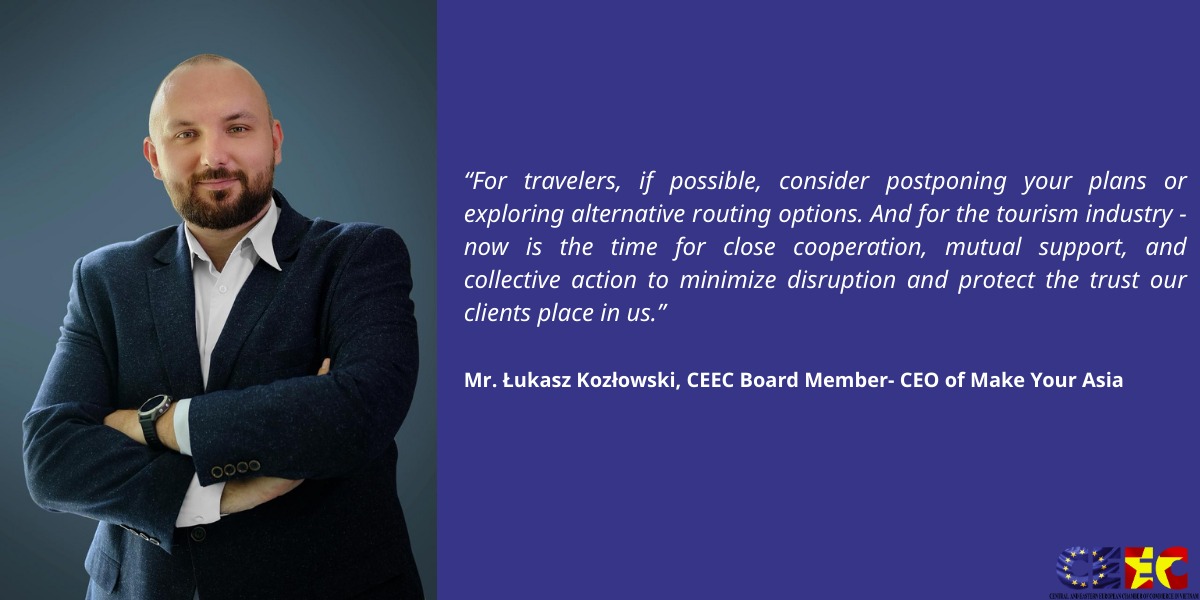
To help our members navigate this volatile environment, CEEC sat down with Mr. Lukasz Kozłowski, CEEC Board Member, CEO of Make Your Asia and a veteran expert in the Travel & Tourism industry.
In this exclusive interview, Mr. Lukasz shares his professional insights on how businesses should adapt their travel strategies, mitigate risks, and maintain operational resilience in 2026.
“ Given the escalating global tensions, what are the most significant immediate shifts you’ve observed in the travel and tourism sector, especially for routes between Europe and Southeast Asia?”
The most immediate and impactful disruption has been the closure and restriction of key air corridors over the Middle East. The majority of routes between Europe and Southeast Asia rely on this region – whether through direct overflight, stopovers, or technical refueling stops, particularly in the case of charter operations.
What we are currently observing is a wave of itinerary changes and re-routing requests from our guests – not only from those traveling this week, but also from clients planning trips one or two months ahead. Uncertainty is influencing decision-making cycles. Travelers are proactively seeking alternative routing options to secure stability before departure.
This creates operational pressure across the ecosystem – airlines, tour operators, and DMCs – as capacity cannot be redistributed overnight.
“Many CEEC members rely on cross-border mobility for their operations. What is your advice for businesses currently planning essential corporate travel or international assignments during this volatile period?”
First and foremost: patience and strategic observation. The first days after any airspace reopening or route adjustment will be critical in understanding how stable the situation truly is. If travel is currently planned through the Middle East corridor, I would strongly recommend exploring alternative routing options.Businesses should also build flexibility into their travel planning – allowing buffer days, refundable tickets where possible, and contingency scenarios. In times like these, agility becomes more valuable than cost optimization.
“With airspace restrictions and rising fuel costs, how should companies recalibrate their travel budgets and expectations for the remainder of 2026?”
It is almost inevitable that ticket prices will increase. The exact scale is difficult to estimate at this stage, as it will largely depend on how long the disruption continues and whether restrictions reoccur intermittently in the coming weeks or months.
In addition to higher fares, companies should prepare for reduced seat availability and longer travel times, as aircraft are forced to operate on extended routes to avoid restricted zones.
For budgeting purposes, I would recommend building in a contingency buffer for international travel for the remainder of 2026, particularly for intercontinental routes between Europe and Asia.
“From a travel expert’s perspective, what are the key ‘safety and compliance’ factors that HR and Operations managers should prioritize to protect their employees traveling abroad right now”
The first priority is route planning – actively avoiding transit through high-risk or restricted regions such as the Middle East airspace.
However, this is operationally complex. Airline networks and aircraft availability cannot be scaled instantly. If hundreds of daily flights are suddenly removed from the system, replacement capacity is limited. Additionally, alternative routes significantly extend flight duration.
HR and Operations teams should carefully assess whether travel is essential at this time. If travel proceeds, comprehensive travel insurance with clear coverage for disruption, rerouting, and emergency support is critical.
Communication protocols are equally important – ensuring employees have real-time contact points and contingency plans.
“Despite the current challenges, do you see any emerging trends or ‘resilience strategies’ within the industry that could offer a sense of stability for the business community?”
Collaboration across the travel ecosystem is now more important than ever – DMCs like MakeYourAsia, airlines, hotels, and transport providers must work closely together to minimize both operational disruption and financial impact for travelers.
Rebuilding and maintaining trust is the key priority, especially as we are currently in the peak holiday season.
We are seeing stronger flexibility policies, faster re-routing assistance, and more proactive communication with guests. The industry has learned significantly from the COVID-19 pandemic – crisis response mechanisms are more structured today, and cooperation is stronger.
I am confident that, as challenging as the current situation is, the travel industry will once again adapt, refine its resilience strategies, and emerge more prepared for future volatility.